

Ever since Mel Robbins popularized The Let Them Theory, people have tattooed, shared, and whispered Let them like a mantra. I enjoyed listening to the audiobook narrated by the author herself — it was like if she was talking directly to me — it felt personal, almost like a conversation.
The title says Let them theory — let people be who they are, let them make their choices.
But the more I listened, the more incomplete just “Let Them” feels. As Mel Robbins insists: let me always follows let them.
The message isn’t whole until you complete it with let me.
Let them is about acceptance.
Let me is about agency.
Together, they balance: respect for others and responsibility for self. Without let me, the phrase risks becoming passive, a surrender. With let me, it becomes empowerment.
A Mirror in Language
Here’s where it gets interesting. There is a way to write it so the symmetry between let them and let me isn’t only conceptual — it’s visual.
Place let me upside down beneath Let them:
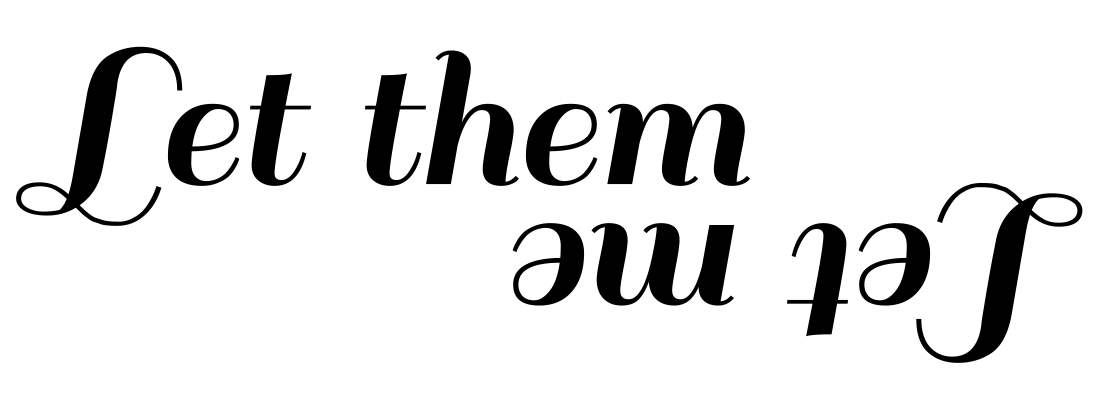
Read the second line as the flipped reflection of let me. Notice how the endings em ↔ me mirror each other, and how let becomes its own reflection when inverted (L ↔ ˥, e ↔ ǝ, t ↔ ʇ). The result is an ambigram: a design where words reveal new meaning when flipped. The philosophy of “let them, let me” is embedded right in the shapes of the letters themselves.
A further twist comes from overlapping t + ʇ = tʇ, which distantly reminds both t and h. This makes the ambigram complete: shifting from let me [to] let them → and returning to let me, all in one continuous line.

Is it simple? Not really — it feels like a puzzle. But maybe that’s the point: sometimes letting them means first stepping over your own ego — the controlling me.
Why It Matters
It’s yin and yang – two halves of a whole.
I believe this symmetry deserves to be seen — and remembered. Whether through mirrored text, an ambigram design, or simply by repeating both phrases, it’s a more complete reminder: let others be who they are, and let yourself step into who you choose to be.
What we have here is not just The Let Them Theory, but a resurfacing of Stoic wisdom in its simplest form: accept the things I cannot change (let them), courage to change the things I can (let me), and wisdom to know the difference — seen now as two mirrored halves of the same truth.